
Marlena: What would you do if God asked
you to invest in something everyone
could see was about to fall apart?
Or maybe somewhere along the way,
did you stop expecting God to
do anything new in your life or
just quietly started surviving?
Hold those two questions.
Let me tell you about a man who had to
answer the first one from inside a prison.
Because for about 40 years, Jeremiah
had warned God's people that if
they kept turning away, Babylon
would come, and almost nobody
listened, and now it was happening.
The Babylonian army had Jerusalem
surrounded, and King Zedekiah had
Jeremiah locked up in the courtyard
of the guard because he didn't
like what the prophet kept saying.
And right there, in the worst real
estate market in the history of
Israel, God told him, go buy a field.
God told Jeremiah that his
cousin, Hanamel, would come and
ask him to buy the family land
back in Anathoth, his hometown.
And that field, from every
visible circumstance, looked
like a terrible investment.
Sure enough, Hanamel showed
up, and Jeremiah bought it.
17 shekels of silver, a signed
deed, witnesses, and the deed
was even sealed and placed in a
clay jar so that it would last.
But it made no financial sense,
and no strategic sense, literally
no tangible or visible sense.
Even Jeremiah wrestled with it.
Right after he completed the
purchase, he prayed both, "Nothing
is too hard for you," and then in
the same prayer essentially asked,
"But God, the city is falling.
Why did you have me buy a field?"
But God answered.
In Jeremiah 32:15, he said,
"Houses, fields, and vineyards
will again be bought in this land."
Hmm.
The field was never about the land.
It was God saying, "There
will still be a future here.
There is more."
And somehow that's what's
comforting me right now, and
maybe it's comforting you, too.
If you wanna sit through the whole
story this week, and I hope you will,
go and read Jeremiah 32, all of it,
and then go back and read the letter
in Jeremiah 29:1-14 at the least.
Keep going if you want.
Connect those dots.
We'll talk about why these
belong together in just a minute.
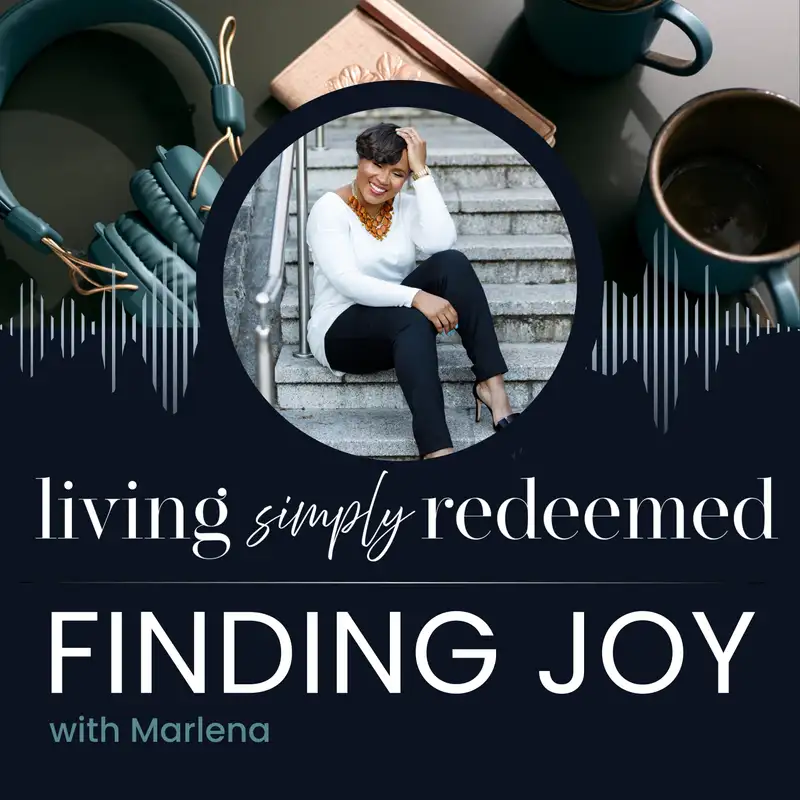
So welcome to episode eight of Living
Simply Redeemed: Finding Joy with Marlena.
I'm so glad you're here.
So grab your tea, your
coffee in a quiet corner.
I already did.
Um, but look, this morning even as
I prepared to record this episode,
I reached for my devotional to
settle in and then I'd pray.
But he stopped me and said, "It's
not about that devotional right now.
It's about communion with me.
This is the space to talk
to me, to wait and to hear."
So I stopped, put everything down,
and I prayed and I listened for a
while.
So if you need to pause
right now, take it.
Hit pause and merely say, in case
you need the words, "Lord, I'm here"
Holy Spirit, I acknowledge you right now.
Father, speak to my heart.
And then stay there until he releases you.
And when you're ready, come on back.
What he has for you matters most.
So today we're sitting with one of my
absolute favorite verses, Jeremiah 29:11.
You already know it.
It's on mugs and graduation
cards and journal covers.
Um, but I want us to hear it the way
it was first heard by the people whose
ground looked ruined because today I think
that's where the promise actually lives,
and I think it has something to say about
your promise and your calling and what
it looks like to expect more from God
again.
Last episode, we talked about what
it takes for God to restore us,
and it came down to three simple
things: rest, nourishment, and time.
Rest.
In Isaiah thirty and fifteen it says, " In
quietness and trust is your strength."
When we finally get still, we
start to recognize God's hand,
not only in the healing after,
but in the preparation before.
Nourishment, not just with bread.
Jesus said in Matthew four, four
that we live by every word that
comes from the mouth of God.
When you feel yourself reaching for
a quick fix, whether that's proving
yourself or staying too busy or
something comfortable or just doom
scrolling, reach for his word instead.
And then there's time.
Healing is not a microwave.
It's more like a seed in the ground,
and for a long while, nothing seems
to be happening on the surface, but
underneath, roots are growing down
long before anything breaks through.
So if restoration takes time,
here's today's question: While I'm
waiting, what do I do with my hands?
And Jeremiah's answer is, "You buy the
field."
Here's something about Jeremiah
twenty eleven that changed it for me.
That verse was written in a letter
that Jeremiah sent to people who had
already been carried off to Babylon.
They'd lost their homes, their
temple, their entire sense of normal.
And just one verse before it, God tells
them this is going to take seventy years.
Seventy years.
That's not a rough season,
that's a whole generation.
And what did God tell them
to do in the meantime?
Buy houses and live in them.
Plant gardens and eat what they produce.
Get married and have children.
Seek the peace of the
city where you're in.
In other words, keep
building, keep sowing.
Don't put your life on pause
until the circumstances change.
Then he says it, "For I know I
have the plans for you, plans to
prosper you, not to harm you, plans
to give you hope and a future."
So this isn't a promise that
nothing hard will happen.
The hard thing had already happened.
It may have already even in your life.
It's a promise about who
God is while you're in it.
In verses twelve and thirteen
finish the thought, "You will
call on me, and I will listen.
You will seek me and find me when
you seek me with all your heart."
That's why I want to say clearly,
expecting more from God is not
a prosperity teaching, mm-mm.
It isn't health on demand,
or wealth on demand.
It's living in the abundance
of his love and his protection
and his provision right here.
And I test that against the rest
of the scripture because he is the
same yesterday, today, and forever.
Romans eight and twenty-eight, "All
things work together for good."
Psalm one twenty-six, "Those who sow
with tears will reap with songs of joy."
In Peter one, five ten, "After all
you have suffered a little while
After you have suffered a little
while, he himself will restore you.
Same God, same character every
time.
So let me tell you a little of my story.
Someone once told me I was naive
as a child because I didn't worry
too much, and honestly, I didn't.
We were definitely not a rich
household, not even close, but
God provided everything we needed.
I never went without the basics.
I didn't really want much more than that.
I didn't need fancy clothes or toys.
I had love I'd give somebody the last
cookie I had and not think twice.
I had a godmother, mentors, teachers,
siblings, and parents who watched over me,
and that same note was always reinforced.
God provided this.
I didn't doubt who he was in my life.
Now, that doesn't mean
my childhood was perfect.
I was bullied.
I was called names.
I saw fights.
I witnessed them.
I was in them.
I witnessed crime.
I experienced grief and loss.
I had my own sin that I wrestled
with too, but God, that indwelling
love and grace never rocked my joy.
Well, not at
first.
A teacher once told me I'd
never be able to write.
Doors to jobs I wanted closed.
The names those kids called
me, I started to believe once.
The, the names adults
called me hit me hard.
There were hard decisions,
sin, losing a parent.
I worked two jobs at one point
to get where I was trying to go.
Someone told me, "You're doing
too much," and what it really
meant to them, you had no focus.
A doctor wondered out loud whether I'd
ever have children with my condition.
One at a time, those things didn't seem
like much, but together they snowballed,
and that childlike faith began to waver.
Instead of hearing his promises, I
heard doubt, a ringing kind of fear.
I was grasping for the confidence I
used to have in myself and in him.
Then came the season that
nearly took the light out of me.
I lost my mom, not long after,
we lost what could have been
our third child to miscarriage.
Abrupt loss on top of loss.
More than one person told me during
that time that the light had gone
out of my eyes, and they were right.
I wasn't hoping anymore.
I was just surviving.
And here's what God showed me.
I hadn't lost my faith,
I had lost my expectancy.
My gaze was fixed on the symptoms and the
fears and the ground that looked ruined.
And if that's where you are today,
I'm not gonna rush you out of it.
I just want you to know that there's a
way back to expectancy, and it starts with
remembering.
In 2 Chronicles 20, King Jehoshaphat
gets word that a massive army is coming
against Judah, and the Bible is honest.
It says he was afraid, but watch
what he does with his fear.
He turns his attention to seek the Lord.
He calls a fast.
All of Judah gathers, babies
and wives and children standing
before God, and Jehoshaphat prays.
He doesn't start with the army.
He starts with God.
"Aren't you the God in heaven?
Aren't you the ruler of all nations?
Didn't you give this land to the
descendants of Abraham, your friend?"
He's building a case for God's goodness
out loud from the record of what God
had already done, and then he ends
with one of the most honest prayers in
scripture, verse two, "We do not know
what to do, but our eyes are on you."
The natural response to troubles is
to rehearse the problem, to replay the
details until they feel even bigger.
But praise moves our eyes.
It puts God back in the
center of the frame.
And for Judah, God answered, "The
battle is not yours, it's mine."
They sent the singers out ahead of
the army, and God won that battle
before they ever lifted a sword.
So let me build my case
the way Jehoshaphat did.
When I was laid off after a company
went under back in twenty ten,
God carried our family for eleven
months without a second income.
Someone even paid for international
travel during that season.
The doctor who doubted I'd ever have
children, God healed my womb, and I
gave birth to my first child, to the
doctor's surprise, and then did it
again seven and a half years later.
Even after I lost Mom, he made room
for nearly a year of sabbatical.
No work, just space to grieve, to
heal, and to hear him more clearly.
And out of that space came a new season
of pouring my faith and my testimony
into others, including this podcast.
He healed relationships
that I was worried about.
He saved people that I prayed for.
He had been so good, and that's
my case, a little bit of it.
But what's
yours?
Some months ago, I watched an interview
with author Susie Larson about her
book, More Than You Can Imagine.
It's built around Ephesians three and 20,
That God is able to do immeasurably more
than all we ask or imagine according
to his power that is at work within us.
And a few things he shared
have stayed with me ever since.
Let's go through those.
Four things.
One, faith and trust
are not the same thing.
As she puts it, faith is your vision.
Believing God is who he says he is.
Trust is your decision,
living like it's true.
And trust can't run on old victories.
It needs a real-time walk with God.
If you want stories to tell tomorrow,
you have to trust him today.
Two, the battle is usually in
the place where trust is hardest.
And the place where trust is
hardest is often the place where
your identity is under attack.
For me, that was my calling, writing and
motherhood, two places someone told me no.
Three, expectation is
different than expectancy.
She described expectation as
premeditated disappointment, it's
when we draw the bullseye and set
the deadline that God has to hit.
If this isn't fixed by October
first, and when he misses
our target, we get offended.
Expectancy, however, is something else.
She called it wide-eyed,
open-handed wonder.
I don't know how, and I don't know
when, but God is going to break through,
possibly differently than I thought.
That is expectancy.
And then fourth, we settle for
less for some very human reasons.
That means we decided in advance what
God will and won't do, and we edit
ourselves down before we even pray.
Abraham did that when he offered
Ishmael in the place of the promise.
Sometimes we're afraid of
being disappointed, and we go
and try to fill it ourselves.
And sometimes, if we're honest,
we don't wanna face the critics
that come with stepping out
. C.S.
Lewis said it this way, in my paraphrase,
"We're like children content to make mud
pies on a slum because we can't imagine
what's meant by a holiday at the sea."
God is offering the sea.
So many of us are afraid even to ask.
And then this one, Susie talked
about a woman at a book signing who
believed in God, but didn't believe his
promises could be for her, not after
a lifetime of failure and abandonment.
Sis, maybe that's you.
You believe God is good.
You just don't believe he's good
toward you, and I want you to hear me.
Jeremiah twenty-nine eleven was
written to people in exile, many of
whom were there, some because of their
own choices, some because of choices
of generations before them, and God
still said, "I have plans for you."
That promise is for you, too.
how did the light come back into my eyes?
The Holy Spirit helped me zoom back out.
Sabbath, prayer, hearing God again,
and then obeying what I heard, and
grace for the journey because I didn't
do it perfectly, and then gratitude.
Not the count your blessings kind,
where you rattle off a list to
make the bad feelings go away.
But sincere, heartfelt gratitude.
The kind where you actually
stop and let it land.
There's a science behind this.
What you focus on becomes what
your brain keeps looking for.
It's like a filter.
You fixate on the symptoms and
the fears, and your mind becomes
very good at finding more of them.
But when you turn toward redemptive
thinking, toward forgiveness and God's
truth instead of your circumstances,
your mind and your body begin to help
you move in that direction instead.
Romans twelve two was saying this long
before any study did: Be transformed
by the renewing of your mind.
Because here's what I've learned.
The hard and the good coexist.
On this side of eternity,
both are always present.
Gratitude doesn't deny the hard.
It just refuses to let the
hard be the only thing you
see.
Now let's talk about purpose
and calling because this is
where the field gets personal.
Susie Larson shared that someone once
asked her how a woman with her health
story could have written all those books.
She's written a lot of them, and
her answer was simple: God's grace
and one obedient step after another,
mostly written in weakness."
She said God told her, "You don't
have to feel well to be powerful."
Remember that teacher
who said I'd never write?
Out of grief, God birthed something
in me, writing to help others move
through what I moved through in
weakness, one obedient step at a time.
God invites us to live a life
bigger than our gifts so the
world can see what he's like.
Don't bury your talent in the ground
like the servant in the parable.
And if you're worried your dream might be
self-ambition, then walk in the Spirit.
He'll purify your motives and
correct your course as you go.
You don't have to have it all figured
out before you take the first step.
Mark Batterson said that there
are decades when nothing happens
and days when decades happen.
Keep sowing in the decades.
Your day is coming.
And even if you don't see all
of it here, it still counts.
Malachi 3:16 says, "A scroll of
remembrance was written in God's
presence about those who feared him."
Every cup of cold water, every
word of encouragement, every
field you bought before the land
looked valuable, he remembers.
Some of the more God has for you,
you'll get to see right here, just
like David said in Psalm 27:13,
"I will see the goodness of the
Lord in the land of the living."
But most of the more, the full
harvest of every seed you've sown in
faith, you won't see until eternity.
So let's live now in a way we
won't regret when we meet Jesus.
Let's live like his promises
are true, because they
are.
So let's get back to Jeremiah.
He bought the field before he
saw the restoration, and that's
the part I wanna talk about.
Right after he signed the deed, he
prayed, and God answered with a question
in Jeremiah thirty-two twenty-seven,
"I am the Lord, the God of all mankind.
Is this too hard for me?"
But keep reading, because
God didn't stop there.
In the verses that follow, he tells
Jeremiah exactly what grieved him.
His people had turned their
backs on him, not their faces.
He taught them again and again,
and they would not listen.
They worshiped the work
of their own hands.
They brought idols right into
the house that bore his name.
They even sacrificed their
own children to false gods.
So I have to ask, don't you see
the same things in the world today?
We may not carve idols out of wood.
Some do.
But we still bow to the
work of our own hands.
Success, image, comfort,
the scroll that never ends.
We turn our backs to God
while we wear his name.
We hear the truth over and over, and
we still don't listen, and our children
are growing up in a world that is
offering them up to so many other gods.
What grieved God then grieves him now.
And here's what undoes me.
Right in the middle of naming
all of that, God makes a promise.
Verse 37, I will surely gather them
from all the lands where I banished them
in my furious anger and great wrath.
I will bring them back to this
place and let them live in safety.
He brings them back.
Then he goes even further.
They will be my people and I will be
their God and I will give them one heart.
I will make an everlasting
covenant with them.
I will never stop doing good to them.
And he says, I will plant them in the
land with all his heart and all his soul.
And the chapter ends, verse 44, with
this, I will restore their fortunes.
That's why Jeremiah bought the field.
Not because he couldn't see
that the judgment was coming.
He saw it more clearly than anyone.
He bought it because he believed the God
who judges is also the God who restores.
So here's the consideration
I want to leave with you.
Many of us can sense the
days are getting shorter.
We can see the brokenness and
God's invitation to us is the
same one he gave Jeremiah.
Don't stop building.
Buy the field anyway.
Jesus told a parable about a
nobleman who handed his servants
resources before he went away.
And in the old King James version, his
instruction was, "occupy till I come."
Keep doing business.
Keep planting.
Keep sowing into your own family,
your calling and your community and
the people God puts in front of you.
Not in spite of knowing the end is
near, but because we know who holds it.
I'm not learning to measure God's
promise by the condition of the ground.
Some things are planted
simply because he said so.
Because he said there will be a future.
Sometimes God asks you to keep
building while everything around
you looks like it's collapsing.
To keep sowing, keep
preparing and keep believing.
Strike the ground again, like
we talked about in episode four.
Obedience can look like foolishness
when we only look at today.
But God was already speaking from
the other side of the devastation.
So here's the hope in it.
The soil may not look ready, but God can
prepare the soil of your heart and the
soil of your circumstances at the same
time He's preparing to hand you the seed.
Your obedience today helps ready the
ground for what He's about to plant.
So let me tell you about my field.
My field right now isn't money.
It's time, effort, and vulnerability.
It's this podcast.
It's the Abiding Grace Planner.
It's sharing the hard parts
of my story as an introvert.
It feels a little like giving my own
oil, trusting it will help someone else
produce their own, because there's power
in being seen and heard, and there's
healing I still need to walk outâ¦
in relationships and with
those who are no longer here.
So I'm letting God till the soil of
my heart, trusting He's preparing new
fruit.
So let's go back to where we started.
I asked what you'd do if God asked
you to invest in something everyone
could see was falling apart.
And I asked if you'd stopped
expecting and started just surviving.
And I told you where I am.
I'm buying a field.
And that little girl who gave away
the last cookie, she's coming back.
Not fully yet, but I'm expecting her.
Joy is her middle name, and finding
joy has always meant finding her again.
The daughter who leaned on
her father without a doubt.
Now I wonder, where are you?
What field is in front of you?
And what would it look
like to expect again?
Expecting again doesn't mean pretending
the hard things didn't happen.
It means opening your hands instead
of clenching them and telling God,
"I don't know how or when, but I
believe you're not finished with me."
Ask yourself, where did I stop
expecting?
So again, truth without a
next step fades by Tuesday.
So here's your one step.
Pick the one with your name on it because
you all might be in different places.
One, if you've lost your
expectancy, just go build your case.
Like Jehoshaphat, write down five
things or however many you choose that
God has already done for you, specific
ones, and read them out loud before
you bring Him your current request.
Read them out loud.
Let that be your gratitude
and your worship.
Two, maybe you've been
holding God to a deadline.
If so, name the bullseye you drew,
then open your hands and pray.
"I don't know how or when, but
I trust you to break through."
Here's a third one.
If there's a false identity you've been
wearing, write down the sentence you
keep saying about yourself next to it.
Write what God says instead.
Read the second one
every morning this week.
Okay
Fourth, if God has been asking you
to buy a field, that step you've been
putting off, the one that doesn't
make visible sense yet, take one
obedient step toward it this week.
Not the whole thing, just the one
step
So let's pray
Father, you know the plans that you have
for us, plans for good and not for harm,
plans to give us a future and a hope.
Thank you that you were already
speaking from the other side of our
devastation before we could see it.
Where we've lost expectancy,
please restore it.
Where we've been drawing bullseyes
and deadlines, just open our hands.
Where we've believed you were good,
but felt like it wasn't for us,
let us hear you call us by name.
Give us courage to buy the field just
to keep building, to sow, and to believe
that while the ground still looks
messy, that nothing is too hard for you.
And Lord, for anyone who doesn't know
where that field is yet, show it to them.
Bring it back to our memory
what you planted long ago.
Give us the courage to tend it and to
restore our expectancy one step at a time.
And for every one of us, bring that
trusting little girl all the way home.
The daughter who leans on
her father without a doubt.
Father, bring her home.
Bring us joy.
And let every woman listening walk
in the calling you placed in her,
in your strength and not in her own.
Lord, we trust you in it and for it.
In Jesus' name, amen.
The way it is today is
not the way it has to end.
You can't change your life
until you change your mind.
And the good news, you can start today.
Trust Him for more.
And thank you for sitting with
me on Living Simply Redeemed,
Finding Joy with Marlena.
Until next time, live
simply and live redeemed